

What Are Eye Floaters and Flashes?
Eye floaters and flashes are visual symptoms associated with changes in the vitreous, the transparent gel that fills the inside of the eye. As the vitreous changes, it can separate from or pull on the retina.
 Floaters inside a patient’s eye.
What Causes Eye Floaters and Flashes?
What Do Eye Floaters and Flashes Look Like?
Floaters may appear as dots, specks, lines, spider-web-like shapes or wavy forms that move across your field of vision.
Flashes may appear as brief flickers or bursts of light, often at the edge of your vision. They may be more noticeable in dim lighting or when moving the eyes.

When Should You See an Eye Doctor?
How Are Eye Floaters and Flashes Treated?
Treatment depends on the underlying cause. Most age-related floaters do not require treatment once a retinal tear or retinal detachment has been ruled out. Over time, floaters often become less noticeable as the brain adapts to them.
Flashes may become less noticeable once the vitreous stops pulling on the retina.
For persistent floaters that significantly interfere with daily activities, laser vitreolysis or vitrectomy surgery may be considered in selected cases.
FAQs
A sudden increase in floaters and lightning flashes is highly suspicious of a retinal tear. Once a retinal tear occurs, a retinal detachment can develop in a short time. The speed of detachment will depend on the size of the tear and how degenerated the gel is. It is advisable to see an eye doctor as soon as possible, preferably within a day if possible.
 Large retinal tear with retinal detachment.
If an eye examination has confirmed that the floaters are not associated with a retinal tear or detachment, active treatment is usually not needed as floaters will usually appear less obvious with time as the brain learns to ignore them. This may take 3-6 months. Sometimes, floaters may also move outside of the central vision area and become less obvious.
There are no effective eyedrops and oral medication for the treatment of floaters. Laser vitreolysis or vitrectomy surgery can effectively remove the floaters. However, they are not usually recommended unless the floaters continue to interfere with daily life after a few months of observation.
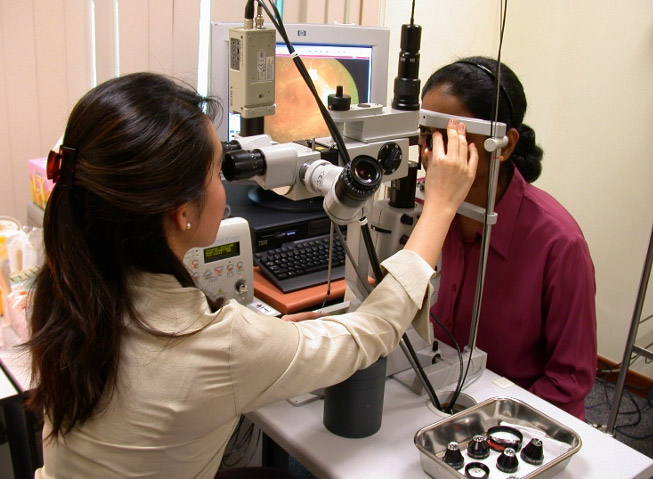 A patient having laser treatment done.
There are no proven food or vitamin supplements as floaters are the result of natural gel degeneration.
There is also no evidence that “eye strain” and daily activities like reading, using the computer, and watching TV cause floaters.
Many eye floaters are harmless, particularly when they develop gradually and remain stable. However, new or sudden floaters or flashes can sometimes indicate a retinal tear or retinal detachment and should be assessed promptly.